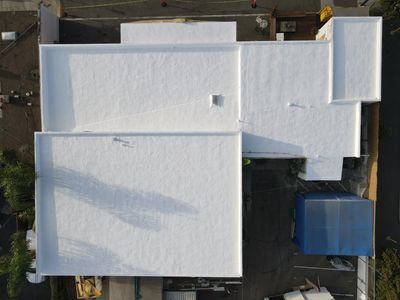
Commercial Spray Foam Roofing in San Diego: What Building Owners Need to Know
If you're a commercial property owner in San Diego, your roof does more than keep the rain out. Your roofing system can affect energy use, indoor comfort, maintenance costs, and the long-term condition of your building.
For many commercial buildings, spray polyurethane foam (SPF) roofing can provide an opportunity to address both roofing and insulation performance in a single system.
At Reaction Spray Foam, we provide commercial spray foam roofing and insulation solutions for businesses and commercial properties throughout San Diego County and Southern California.
Whether you're dealing with an aging commercial roof, rising cooling costs, difficult-to-insulate areas, or a roof that needs to be restored rather than completely replaced, understanding your options can help you make a better decision.
What Is Commercial Spray Foam Roofing?
Commercial spray foam roofing is a roofing system that uses spray polyurethane foam as the insulation and roofing substrate, followed by a protective roof coating.
The foam is applied to an appropriate roof surface using specialized equipment. As it is installed, the foam expands and forms a continuous layer over the prepared substrate. A protective coating is then applied over the foam to help protect the roofing system from weather, UV exposure and normal environmental conditions.
Unlike many traditional roofing systems that rely on numerous seams and joints, a properly installed spray foam roofing system can create a seamless surface with significantly fewer seams and penetrations.
The exact system, thickness, coating and preparation requirements depend on the building, existing roof and manufacturer's specifications.
Why Is Spray Foam Roofing a Good Option for San Diego Commercial Buildings?
San Diego's climate creates some unique considerations for commercial roofing.
Buildings experience substantial sun exposure, warm temperatures, occasional heavy rainfall, and temperature changes throughout the year. A commercial roof needs to withstand those conditions while helping protect the building underneath.
Spray foam roofing can provide several potential advantages.
1. Seamless Roofing
One of the major advantages of spray foam roofing is its ability to create a continuous surface.
Traditional roofing systems can contain seams, joints and numerous transitions. These areas require careful installation and maintenance because they can become potential points of failure.
Spray foam is applied continuously across the roof surface and can conform to many irregular shapes and transitions.
That doesn't mean a spray foam roof is maintenance-free. Proper preparation, installation, drainage and ongoing maintenance are still essential.
2. Added Insulation
A major difference between spray foam roofing and many conventional roof coating systems is that spray foam can provide thermal insulation as part of the roofing assembly.
The foam creates a layer of insulation directly on the roof deck or existing roof assembly.
For commercial buildings with inadequate roof insulation, this can be an important consideration.
Improving the thermal performance of the roof can help reduce heat transfer through the roof assembly and may reduce the workload placed on the building's HVAC system.
Actual energy savings vary depending on the building, existing insulation, HVAC equipment, occupancy, roof design and other factors.
3. Helps Address Air Leakage
Air leakage can be an important source of energy loss in commercial buildings.
A properly designed spray foam roofing system can help reduce uncontrolled air movement through gaps and irregular areas of the building envelope.
This is particularly valuable when a building has areas that are difficult to insulate using traditional materials.
Instead of simply adding another layer of material, spray foam can provide both insulation and air sealing.
4. Works With Many Commercial Roof Configurations
Commercial buildings don't all have simple, flat roof surfaces.
Roofs may contain:
- HVAC penetrations
- Pipes
- Curbs
- Drains
- Skylights
- Equipment platforms
- Parapets
- Irregular transitions
- Multiple roof sections
Spray foam can conform to many of these shapes, making it useful for certain commercial roofing applications.
However, every roof should be evaluated individually before determining whether SPF roofing is appropriate.
5. Potentially Extend the Life of an Existing Roof
One of the questions we hear from commercial property owners is:
"Do I have to completely replace my roof?"
Not necessarily.
Depending on the existing roof's condition, substrate, moisture levels, drainage and other factors, a spray foam roofing system may be an option for restoring or re-covering an existing roof rather than removing the entire roofing system.
A professional inspection is essential.
If the existing roof has significant moisture intrusion, structural deterioration or other problems, simply covering it isn't necessarily the right solution.
The goal should always be to build a roofing system on a sound, properly prepared substrate.
Spray Foam Roofing vs. Traditional Commercial Roofing
There isn't one roofing system that's right for every commercial building.
The right choice depends on factors such as:
- Existing roof condition
- Roof design
- Building use
- Drainage
- Insulation requirements
- Budget
- Expected service life
- Maintenance requirements
- Future building plans
- Local code requirements
Spray foam roofing is particularly interesting when a building owner wants to address roofing and insulation performance together.
A traditional roof replacement may still be the better choice for some buildings.
That's why an evaluation should come before a recommendation.
Is Spray Foam Roofing Energy Efficient?
This is one of the biggest reasons commercial building owners consider SPF roofing.
The roof is one of the major areas where a building can gain or lose heat. Improving the roof assembly's insulation and air-sealing characteristics can help reduce heat transfer.
The protective roof coating can also be selected with solar reflectance and thermal-emittance characteristics appropriate to the roofing system and project requirements.
California's 2025 Building Energy Efficiency Standards apply to applicable building projects with permit applications submitted on or after January 1, 2026. San Diego has also adopted local amendments addressing roof-covering requirements, including cool-roof provisions for certain nonresidential projects.
Important: Roofing systems should be designed and specified based on the actual project requirements and applicable code—not simply because a particular product is marketed as "energy efficient."
What Types of Commercial Buildings Can Use Spray Foam Roofing?
SPF roofing can be considered for many different types of commercial and industrial properties.
Reaction can work with projects involving:
Warehouses
Large warehouse roofs can benefit from insulation and air-sealing improvements, particularly where temperature control and energy efficiency are important.
Manufacturing & Industrial Buildings
Industrial buildings often have large roof areas and complicated penetrations for equipment, ventilation and utilities.
Office Buildings
Improving roof insulation can contribute to overall building comfort and energy performance.
Retail Buildings
Retail properties can have significant HVAC loads and large roof areas that receive substantial sun exposure.
Agricultural & Specialty Buildings
Spray foam can also be appropriate for certain agricultural and specialty structures depending on the building design and intended use.
Commercial Garages & Storage Buildings
Large-span structures can have unique insulation challenges that make spray foam worth considering.
San Diego Commercial Roofing and Building Codes
Commercial roofing projects in San Diego need to account for applicable California and local requirements.
The City of San Diego's current regulations incorporate the 2025 California Building Standards Code, with local amendments. The city notes that the 2025 codes apply to projects submitted on or after January 1, 2026.
Roof replacement and roof-covering renewal projects may also trigger additional requirements depending on the project.
For example, San Diego's roofing guidance addresses permitting, roof assembly classifications and situations where roof replacement can trigger California Energy Code requirements.
This is one reason commercial property owners should work with a contractor who understands the requirements that apply to their particular project.
How Long Does a Commercial Spray Foam Roof Last?
The service life of a spray foam roofing system depends on several factors, including:
- Installation quality
- Coating system
- Roof exposure
- Maintenance
- Weather
- Foot traffic
- Building conditions
- Repairs
- Coating thickness and renewal
A spray foam roof should not be viewed as a "set it and forget it" system.
Regular inspections and maintenance are important for maximizing the life of the roof.
Maintaining the protective coating is particularly important because the coating protects the underlying foam from UV exposure and weather.
How Does Commercial Spray Foam Roofing Installation Work?
A successful SPF roofing project begins well before the foam is sprayed.
Step 1: Roof Evaluation
The existing roof and building conditions should be evaluated to determine whether spray foam roofing is appropriate.
This may include examining:
- Existing roofing materials
- Roof deck condition
- Moisture
- Drainage
- Flashings
- Penetrations
- Existing insulation
- Structural conditions
Step 2: Surface Preparation
The existing substrate needs to be properly prepared before the foam is applied.
Cleaning, repairs, drying and preparation requirements depend on the existing roofing system.
Step 3: Spray Foam Application
The SPF is applied using specialized equipment and according to the requirements of the selected product and system.
Proper temperature, pressure, substrate conditions and application thickness are important to achieving the intended results.
Step 4: Protective Coating
After the foam is installed and properly prepared, a protective coating is applied over the foam.
The coating helps protect the system from UV exposure and weather.
Step 5: Inspection & Final Details
The completed roof should be inspected, including transitions, penetrations, drains, edges and other critical areas.
Should You Repair, Recoat or Replace Your Commercial Roof?
If your commercial roof is aging, you may be wondering whether you should repair it, install a new coating, install a spray foam system, or completely replace it.
There isn't one answer for every building.
A professional evaluation should consider:
Repair:
Appropriate when damage is limited and the overall roof remains in good condition.
Recoat:
Potentially appropriate when the existing roof is suitable for a compatible coating system and the underlying assembly is sound.
Spray Foam Roofing:
May be appropriate when adding insulation and creating a seamless roofing system are important goals.
Complete Replacement:
May be necessary when the existing roof or substrate has significant deterioration or moisture problems.
The right decision should be based on the condition of the existing roof—not simply the lowest initial price.
Why Choose Reaction for Commercial Spray Foam Roofing?
Commercial roofing is a significant investment.
At Reaction, we focus on providing professionally installed spray foam insulation and roofing systems for commercial and industrial applications throughout San Diego County and Southern California.
We understand that commercial property owners aren't just looking for someone to spray foam.
They're looking for a contractor who understands:
- Roof preparation
- Insulation performance
- Air sealing
- Roof drainage
- Commercial building conditions
- Roofing details
- Long-term maintenance
Our goal is to provide a roofing system that is appropriate for the building and installed with attention to the details that affect long-term performance.
Commercial Spray Foam Roofing in San Diego County
Reaction serves commercial customers throughout San Diego County and surrounding Southern California communities, including:
San Diego • Vista • Oceanside • Carlsbad • San Marcos • Escondido • Encinitas • Poway • La Jolla • Del Mar • Rancho Santa Fe • Fallbrook • Bonsall • Temecula • Murrieta and surrounding areas
If you're outside these areas, contact us to see whether we can help with your project.